
What is Manufacturing?
Manufacturing is a core industrial and engineering concept that focuses on transforming raw materials into finished or semi-finished products through a sequence of well-planned processes. These processes use machines, tools, energy, labor, and modern digital technologies to ensure products are produced accurately, efficiently, and repeatedly. In practice, manufacturing connects product design with real-world application, making it possible for ideas and engineering drawings to become physical objects that people can use.
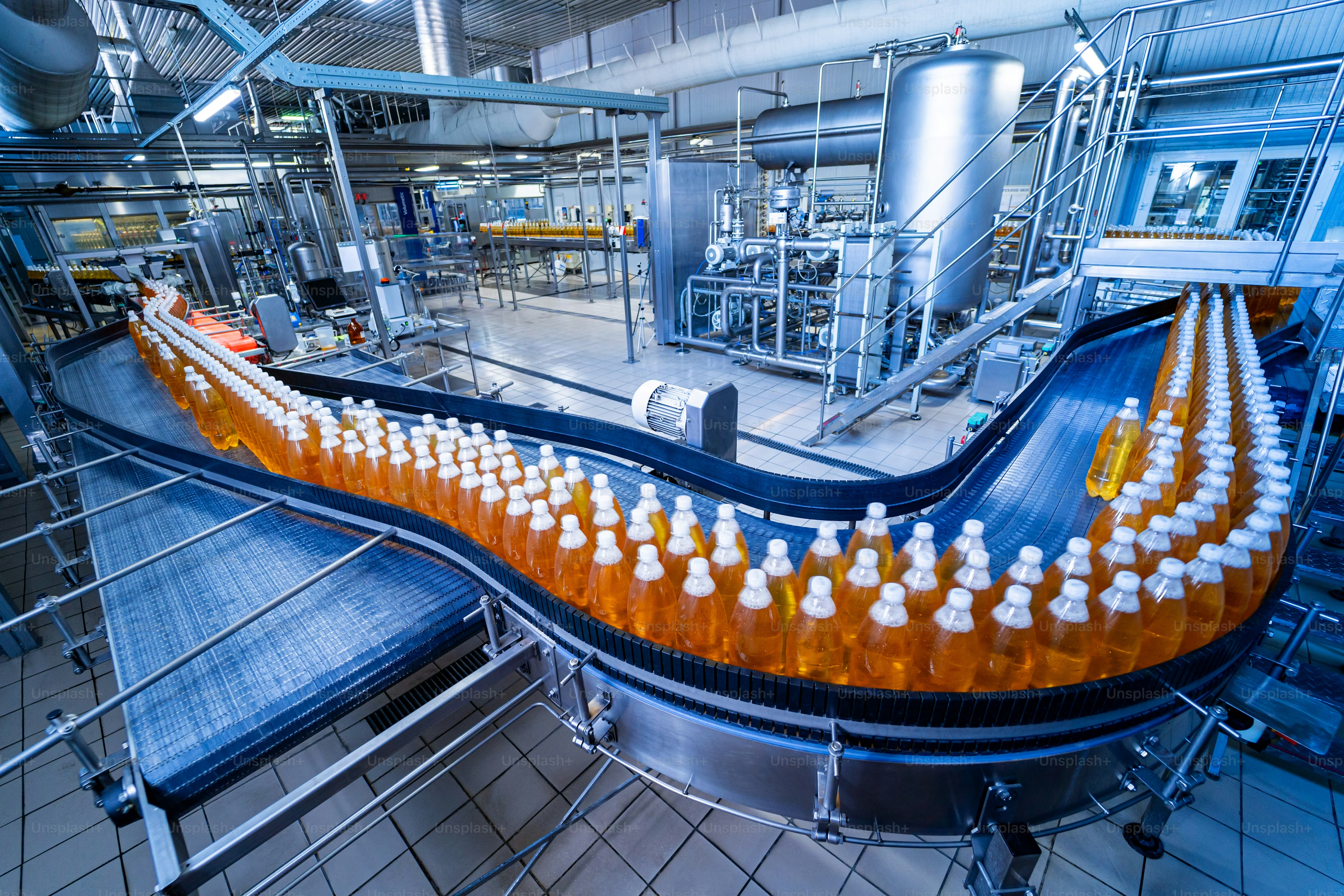
Manufacturing is a fundamental concept in engineering and industrial systems that focuses on converting raw materials into finished products through a sequence of controlled and well-defined processes. These processes involve the use of machines, tools, energy, skilled labor, and increasingly, digital technologies such as automation and data-driven systems. Manufacturing is not merely about producing goods; it emphasizes precision, efficiency, quality, repeatability, and the ability to scale production to meet demand.
In practical terms, manufacturing serves as the critical link between product design and real-world application. A design or engineering concept holds limited value unless it can be produced reliably, economically, and at the required quality level. Manufacturing enables this transition by transforming ideas, drawings, and prototypes into usable products that meet functional and performance requirements.
Manufacturing can be defined as the systematic transformation of raw materials—such as metals, polymers, ceramics, and composites—into usable or market-ready products. This transformation is achieved through a variety of physical, mechanical, and chemical processes, selected based on material properties, design specifications, production volume, and cost considerations. For example, casting is commonly used to produce complex shapes like engine blocks by pouring molten metal into molds, while machining processes such as turning and milling are employed to achieve high dimensional accuracy in components like shafts and gears. Forming processes, including rolling and forging, reshape materials through applied force, whereas joining processes such as welding and riveting assemble multiple parts into a single structure. Additive manufacturing, or 3D printing, represents a modern approach in which components are built layer by layer, making it especially useful for complex geometries and customized products such as medical implants.
Manufacturing plays a vital role in engineering and industrial development by enabling consistent, large-scale production of high-quality products. Industries rely on robust manufacturing systems to meet performance standards while maintaining efficiency and cost control. In the automotive sector, for instance, manufacturing ensures that thousands of components such as pistons, gears, and brake discs are produced within strict tolerance limits to ensure safety and reliability. In electronics, advanced micro-manufacturing techniques make it possible to fabricate printed circuit boards and semiconductor chips with extremely high precision. Similarly, in the construction industry, manufacturing supports the mass production of standardized materials such as steel beams, pipes, and prefabricated structural components, improving both speed and quality of construction.
An essential element of manufacturing is quality control, which ensures that products meet predefined standards related to dimensions, strength, durability, and safety. Quality control is integrated throughout the manufacturing process rather than being limited to final inspection. For example, bearings must be manufactured with precise tolerances to minimize friction and prevent premature failure, while medical devices must comply with strict regulatory standards to ensure patient safety. Tools such as statistical process control, precision inspection instruments, and automated testing systems are widely used to maintain consistency, detect defects early, and reduce waste.
Advanced Robotics and Automation are transforming the role of machines on the factory floor. Modern industrial robots are no longer isolated behind safety cages. Collaborative robots are designed to work safely alongside humans. These robots perform repetitive, precise, or hazardous tasks while human workers focus on higher-value activities such as problem-solving and process optimization. Automation powered by intelligent software allows robots to adapt to different tasks and production requirements, increasing flexibility and efficiency.
Additive Manufacturing, commonly known as 3D printing, is another key enabler of Industry 4.0. It allows manufacturers to create complex parts directly from digital designs with minimal material waste. Additive manufacturing supports rapid prototyping, faster product development cycles, and mass customization. By integrating 3D printing into digital production workflows, companies can decentralize manufacturing and respond quickly to changing customer demands.
Cybersecurity is a critical foundational element of Industry 4.0. As industrial systems become more connected, they also become more vulnerable to cyber threats. Protecting sensitive data, intellectual property, and operational systems requires robust cybersecurity strategies that include secure network architectures, encryption, continuous monitoring, and employee awareness. Without strong security measures, the benefits of Industry 4.0 cannot be fully realized.
In summary, Industry 4.0 is driven by a powerful combination of interconnected technologies that work together to create intelligent, autonomous, and highly adaptable industrial systems. By leveraging IoT, AI, big data analytics, cyber-physical systems, cloud and edge computing, robotics, additive manufacturing, and cybersecurity, organizations can transform traditional operations into smart, future-ready enterprises. This transformation is not just about adopting new tools, but about redefining how value is created in the digital age.
Major Applications of Product Simulations
Mechanical and Structural Evaluation
Industries such as automotive, aerospace, and manufacturing use simulations to test:
- Load-bearing capability
- Fatigue and failure points
- Vibrations and mechanical stress
- Crashworthiness and impact performance
Finite Element Analysis (FEA) is a widely used method for predicting how structures will react under various forces.
Thermal and Fluid Dynamics
Thermal simulations help visualize heat flow and temperature changes within a product.
Fluid simulations—powered by Computational Fluid Dynamics (CFD)—analyze the behavior of gases and liquids.
These tools help improve:
- Cooling systems
- Aerodynamic performance
- Fuel efficiency
- Ventilation and airflow
Electrical and System-Level Modeling
In electronics and IoT development, simulations are used to enhance:
- Circuit performance
- Battery efficiency
- Electromagnetic compatibility
- Power consumption
This is especially critical as devices become smaller, smarter, and more interconnected.
User Experience and Human Interaction
With the rise of digital twins, VR, and ergonomic modeling, simulations now extend into the user experience:
- Testing ergonomics and comfort
- Evaluating accessibility
- Modeling human-device interaction
These insights help companies create products that are intuitive and user-friendly.
Conclusion
Industry 4.0 is driven by a powerful combination of interconnected technologies that work together to create intelligent, autonomous, and highly adaptable industrial systems. By leveraging IoT, AI, big data analytics, cyber-physical systems, cloud and edge computing, robotics, additive manufacturing, and cybersecurity, organizations can transform traditional operations into smart, future-ready enterprises. This transformation is not just about adopting new tools, but about redefining how value is created in the digital age.